
Research
From the first femtoseconds to working devices
We are driven by curiosity about how energy moves through matter, and by what that understanding could make possible: solar cells that waste less sunlight, batteries that charge faster and last longer, and light sources that are purer and more efficient. Our approach is to build instruments that measure what could not previously be measured, to follow the physics wherever it leads, and to carry the best ideas from the laboratory into working devices and, through our spin-out companies, into industry.
Ultrafast spectroscopy and microscopy
In brief
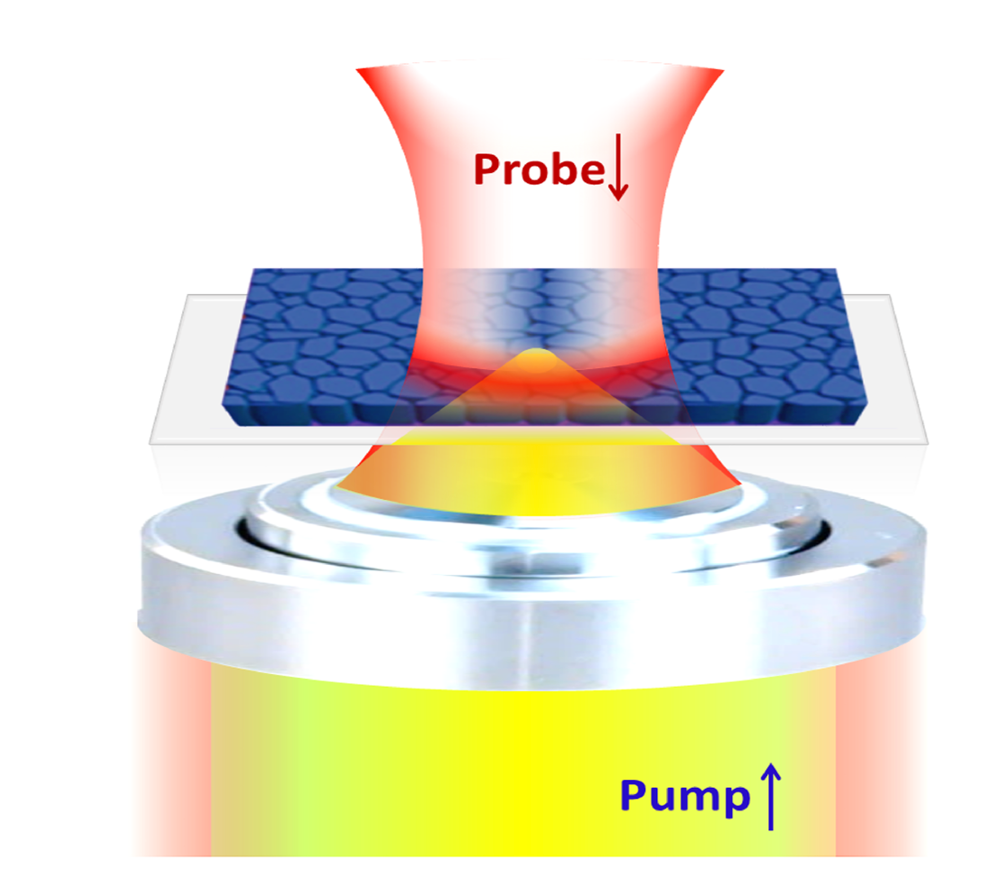
Many of the processes that determine how well a solar cell or light-emitting material works are complete within a trillionth of a second and take place over a few nanometres. We build optical microscopes and spectrometers that follow these processes directly, with a time resolution below 10 femtoseconds and a spatial precision below 10 nanometres.
The science
Our transient absorption microscopes track how excitons and charges move in space and time, and impulsive vibrational spectroscopy follows how molecular vibrations couple to electronic states. With these methods we identified transient delocalisation, a transport regime in which excitons in highly ordered polymer nanofibres travel about 300 nanometres, roughly one hundred times further than conventional hopping allows. We also showed that excitons in organic molecules can be decoupled from high-frequency vibrations, removing a loss pathway previously considered unavoidable.
We are extending these methods towards the single-photon limit: field-resolved detection of light pulses has reached yoctojoule (10−24 J) sensitivity with attosecond precision. The same tools have been applied to biological light harvesting, where ultrafast spectroscopy of living cyanobacteria showed that electrons can be extracted from photosystems within picoseconds of excitation.
Key papers
- Decoupling excitons from high-frequency vibrations in organic moleculesGhosh et al., Nature (2024)
- Photosynthesis re-wired on the pico-second timescaleBaikie et al., Nature (2023)
- Efficient energy transport in an organic semiconductor mediated by transient exciton delocalizationSneyd et al., Science Advances (2021)
- Fieldoscopy at the quantum limitZimin et al., Light: Science & Applications (2026)
- Extracting quantitative dielectric properties from pump-probe spectroscopyAshoka et al., Nature Communications (2022)
Charge photometry
Charge photometry: watching batteries at work
In brief
Batteries store energy by moving lithium ions into and out of microscopic particles in their electrodes. How quickly and how uniformly this happens determines how fast a battery can charge and how long it lasts, yet it has been difficult to observe directly. We developed charge photometry, an optical microscopy that follows individual particles inside a working battery as it charges and discharges.
The science
Charge photometry is based on interference reflection microscopy. As lithium ions enter or leave an active particle, its refractive index changes, and the scattered light reports the local state of charge. Because this principle does not depend on the battery chemistry, the method applies to a wide range of electrode materials and can follow many single particles during realistic cycling.
With charge photometry we have followed phase transitions and lithium diffusion in individual particles of LiCoO2, the most widely used commercial cathode material, and found different mechanisms on charge and discharge. We have visualised state-of-charge heterogeneities and cracking in high-rate anodes and nickel-rich cathodes, and shown that lithium enters graphite in avalanche-like steps linked to static disorder. The same approach has been applied to photo-redox phase engineering of transition-metal dichalcogenides and to electrochemical doping of conjugated polymers.
Charge photometry is being commercialised by illumion.

Video: Cavendish Laboratory, on avalanche-like lithium intercalation in graphite.
Key papers
- Operando optical tracking of single-particle ion dynamics in batteriesMerryweather et al., Nature (2021)
- Avalanche-like intercalation and intraparticle correlations in graphiteHan et al., Nature (2026)
- Operando monitoring of single-particle kinetic state-of-charge heterogeneities and cracking in high-rate Li-ion anodesMerryweather et al., Nature Materials (2022)
- Operando visualization of kinetically induced lithium heterogeneities in single-particle layered Ni-rich cathodesXu et al., Joule (2022)
- Operando single-particle imaging reveals that asymmetric ion flux contributes to capacity degradation in aged Ni-rich layered cathodesLun et al., Energy & Environmental Science (2025)
- Photoredox phase engineering of transition metal dichalcogenidesLim et al., Nature (2024)
- Hole-limited electrochemical doping in conjugated polymersKeene et al., Nature Materials (2023)
Singlet fission
Singlet fission for solar energy
In brief
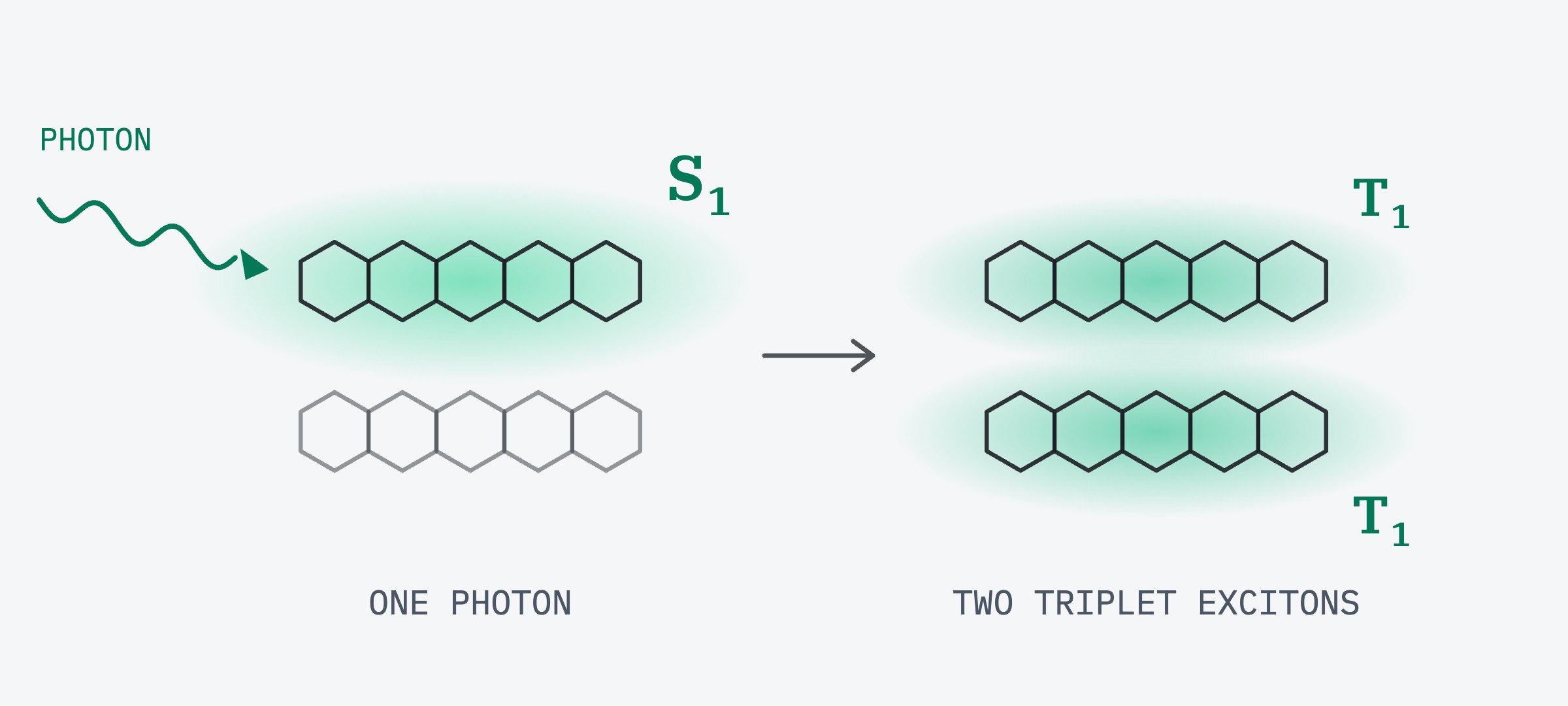
Silicon solar cells convert only part of the energy in sunlight: the excess energy of blue and green photons is lost as heat. In certain organic molecules, a process called singlet fission divides the energy of one absorbed photon into two excited states. If both can be captured, a solar cell could exceed the efficiency limit for a single-junction device.
The science
Singlet fission converts a spin-singlet exciton into two spin-triplet excitons through an intermediate triplet-pair state. Using coherent two-dimensional electronic spectroscopy, we observed the multiexcitonic states that mediate ultrafast fission and the vibronic coupling that drives it. We have mapped how triplet pairs form in endothermic fission systems as a function of excitation energy, and imaged fission directly in three dimensions.
To use fission in photovoltaics, the triplet excitons must be passed to an emitter whose light silicon can absorb. We have developed blend films in which fission proceeds with a 190% triplet yield and the triplets transfer to inorganic nanocrystals with near-unity efficiency. This is the basis of the singlet-fission photon multiplier, a film designed to sit on top of a silicon solar cell.
The photon multiplier is being developed by Cambridge Photon Technology.
Key papers
- Harnessing singlet exciton fission to break the Shockley–Queisser limitRao and Friend, Nature Reviews Materials (2017)
- Real-time observation of multiexcitonic states in ultrafast singlet fission using coherent 2D electronic spectroscopyBakulin et al., Nature Chemistry (2016)
- Elucidation of excitation energy dependent correlated triplet pair formation pathways in an endothermic singlet fission systemThampi et al., Journal of the American Chemical Society (2018)
- Direct observation of ultrafast singlet exciton fission in three dimensionsAshoka et al., Nature Communications (2022)
- Ligand-directed self-assembly of organic-semiconductor/quantum-dot blend films enables efficient triplet exciton–photon conversionGray et al., Journal of the American Chemical Society (2024)
Organic–lanthanide nanoparticles
In brief
Nanoparticles doped with lanthanide ions emit light in very narrow bands, from the visible to the near infrared, which makes them attractive for medical imaging, sensing and optical communication. They have two limitations: they absorb light weakly, and they are electrical insulators, so they cannot be used directly in light-emitting diodes. We overcome both by attaching organic molecules that act as antennas.
The science
The organic molecules absorb light, or accept injected charges, and form triplet excitons, which then transfer their energy to the lanthanide ions. We first showed that lanthanide-doped nanoparticles can harvest molecular triplet excitons in this way, turning otherwise dark triplet states bright. We have since found that triplet energy transfer from the ligands to the nanoparticles proceeds with near-unity efficiency, and engineered nanoparticle shells to pass energy efficiently between layers.
Driving the same process electrically, organic semiconductors conduct current, form triplet excitons and pass them to the lanthanide ions. This has produced light-emitting diodes from these insulating nanoparticles, with narrow-band near-infrared emission that includes the telecommunications wavelengths of 1330 and 1550 nm. In the reverse direction, spin-exchange coupling to the lanthanide ions allows organic triplet states to be excited directly, giving room-temperature phosphorescence in solution.

Key papers
- Lanthanide-doped inorganic nanoparticles turn molecular triplet excitons brightHan et al., Nature (2020)
- Triplets electrically turn on insulating lanthanide-doped nanoparticlesYu et al., Nature (2025)
- Lanthanide-doped nanocrystals enable organic room-temperature phosphorescence in solution through direct triplet excitationZhu et al., Nature Chemistry (2026)
- Distance-independent efficiency of triplet energy transfer from π-conjugated organic ligands to lanthanide-doped nanoparticlesvan Turnhout et al., Journal of the American Chemical Society (2024)
- Active shell engineering for efficient cascade triplet energy transfer in lanthanide heterostructuresJiang et al., Angewandte Chemie International Edition (2026)
Inside the laboratory
Our laboratories are in the state-of-the-art Ray Dolby Centre and Maxwell Centre at the Cavendish Laboratory. They house ultrafast laser systems and the optical microscopes and spectrometers that we design and build, charge-photometry instruments for operando battery studies, and facilities for making materials and devices.
RAO Lab (Cavendish Laboratory)
The opening of the Ray Dolby Centre (University of Cambridge)